Recover boards, validate fixes, and reduce replacement cost. Our controlled BGA reballing process with X-ray inspection supports failure analysis, revision migrations, and cost-effective assembly recovery.
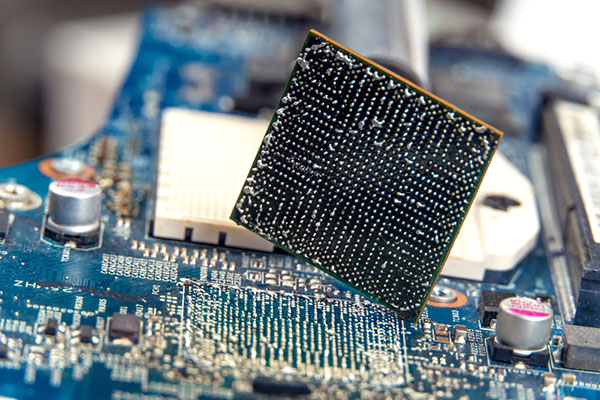
High-value assemblies with BGA, CSP, or LGA devices don’t need to be scrapped when joint integrity fails or a revision migration requires component reuse. Circuits Central provides controlled BGA reballing and rework services with X-ray inspection at every stage, IPC-7711/7721-referenced process discipline, and full documentation from incoming assessment through release.
This page is aimed at electrical engineers, hardware designers, and NPI teams who already understand BGA rework fundamentals. The focus here is on process control, failure modes, go/no-go criteria, and what information you need to provide for an efficient, reliable outcome.
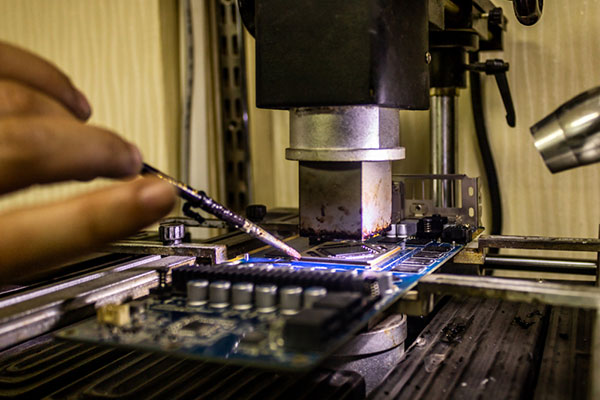
Our rework capability covers the full range of BGA-related interventions:
Device Removal & Reattachment
Profiled hot-air removal with board-specific ramp rates. Reattachment using validated reflow profiles for the package and PCB thermal mass. All cycles logged.
Reballing
Solder sphere application via stencil or tooling matched to ball pitch. SAC305 and Sn63Pb37 alloys supported. Circuits Central has developed an internally refined technique for cost-effective, repeatable sphere placement.
X-Ray Inspection
Pre- and post-rework X-ray at defined inspection gates. Results documented against your acceptance criteria — bridging, voiding, ball collapse, misalignment, and missing balls.
Pad & Site Repair
Pad lifts, trace repairs, and landing site restoration assessed and executed per IPC-7711/7721 guidelines when substrate condition permits. No rework proceeds on a site that cannot support a reliable reattachment.
Failure Analysis Support
Device swap for diagnostic purposes, pre-rework cross-section coordination, and failure characterization inputs for your FA report. Usable for DMIR and field return investigation workflows.
Documented Rework Record
Full traveller per unit: incoming condition, inspection results at each gate, profile data, sphere alloy used, pass/fail disposition, and any recommendations for preventing recurrence.
The incoming evaluation determines whether reballing is appropriate before any heat is applied. Factors that affect the go/no-go decision:
| Factor | Acceptable | Elevated Risk / Recommend Evaluate Further |
|---|---|---|
| Pad integrity | All pads present, no lifted traces, no delamination at pad edges | Lifted pads, trace damage, exposed copper under mask — pad repair feasibility assessed first |
| Underfill | No underfill present | Underfilled BGAs require underfill removal prior to rework — risk of pad damage is significantly higher |
| Prior rework cycles | Zero or one documented cycle | Multiple thermal cycles increase laminate fatigue risk; each additional cycle degrades reliability margin |
| Board warpage | Within IPC-7711 flatness tolerances for the package footprint | Warpage beyond tolerance increases voiding probability and risks non-uniform ball collapse during reflow |
| Contamination | No visible flux residue, corrosion, or moisture exposure | Contaminated sites require cleaning and assessment before proceeding; moisture in laminate requires baking |
| Package type | Standard BGA, PBGA, CBGA, micro-BGA | Embedded die packages, stacked PoP, or devices with known fragile substrates — feasibility confirmed on a case-by-case basis |
| Intervention | Indicated When | Contraindicated When |
|---|---|---|
| Reflow only | Failure mode is head-in-pillow, insufficient wetting, or cold joint confirmed by X-ray. Device confirmed functional. Zero prior rework cycles. | Device suspected faulty. Ball collapse already occurred. Multiple prior thermal cycles. Any pad damage present. |
| Remove & reball | Joint-related failure mechanism confirmed. Device reusable. Pad integrity confirmed. Revision migration where new PCB revision requires same device. | Underfill present without removal plan. Board warpage exceeds tolerance. Laminate damage visible under X-ray. Unknown thermal history. |
| Replace device | Device functionally suspect. Rework risk assessed as high. Part readily available. Multiple prior rework cycles already on the site. | Part unavailable or long lead time — reball may then be the only viable path, with appropriate risk acknowledgement. |
Initial Assessment
Review of failure symptoms, board assembly revision, prior rework history, and physical inspection for warpage, contamination, underfill presence, and pad condition. Go/no-go determination before committing to scope. Boards with unacceptable risk are returned with written assessment — no rework attempted.
Pre-Rework X-Ray Baseline
X-ray images captured and documented before any thermal cycle. Establishes baseline for bridging, voiding percentage, ball uniformity, and alignment. Results compared post-rework to confirm improvement — not just assumed.
Device Removal
Profiled hot-air removal with board-specific preheat and ramp rates to minimize thermal gradient across the assembly. Adjacent component protection applied where required. Peak temperature, soak time, and cool-down rate logged per unit.
Site Preparation
Residual solder removed via wick and hot-air. Pad surfaces cleaned, inspected under magnification, and conditioned. If pads are damaged, repair feasibility is assessed per IPC-7711/7721 before proceeding. Baking applied if moisture ingress is suspected.
Reballing
Sphere placement via laser-cut stencil or dedicated tooling matched to ball pitch and package outline. Reflow of spheres under controlled profile with flux appropriate to alloy. Sphere uniformity and completeness verified under microscope before proceeding to reattachment.
Reattachment & Post-Rework X-Ray
Device placed with optical alignment verification, then reflowed per a validated profile for the package/board combination. Post-rework X-ray compared against pre-rework baseline and acceptance criteria. Pass/fail disposition documented with image records.
Release Documentation
Full unit traveller released with incoming condition notes, X-ray images (pre and post), profile logs, sphere alloy used, inspection disposition, and any recommendations. Format can be aligned to your DMIR, field return, or production rework record requirements.
The following information reduces turnaround time and improves assessment accuracy:
We support both SAC305 (Pb-free, RoHS-compliant) and Sn63Pb37 (leaded). If the device was originally shipped with SAC305 balls and is being returned to a leaded assembly, we’ll confirm the appropriate alloy with you before reballing — mixing alloy systems in a reworked joint has reliability implications at the interface that should be a deliberate decision, not a default. We also support mixed-alloy BGAs where the package substrate uses a different alloy from the board-side pads.
Underfilled BGAs can be reworked, but underfill removal must be scoped and completed before any thermal removal cycle. The removal method — chemical, mechanical, or a combination — depends on the underfill formulation and whether pad preservation is the priority. The risk of pad damage during underfill removal is significant, especially for fine-pitch arrays. If you have a board with an underfilled BGA that needs rework, flag it explicitly when submitting so we can assess feasibility and discuss the approach before committing to a scope.
Trustindex verifies that the original source of the review is Google. Excellent PCB assembly services. We have had an excellent experience with Circuits Central. - Turn Around Time: Boards were always assembled on time including expedited projects with 24-hour TAT. - Customer Service: Customer service is fast to respond over email and resolve any outstanding issues very quickly. - Quality: Excellent assembly quality with no errors or issues including for complex projects. - Communication: Circuits Central made the jobs simple to submit. We didn't have to submit many files or prepare every last detail for them.Posted onTrustindex verifies that the original source of the review is Google. Circuits Central has been making our boards for over 25 years. They are a great company to work with.Posted onTrustindex verifies that the original source of the review is Google. Great customer service! Highly recommend the team at CCIPosted onTrustindex verifies that the original source of the review is Google. I've been using Circuits Central for over 10 years for all of our NPI projects. Workmanship is exceptional and deliveries are always on time. Many thanks to the Circuits Central team.Posted onTrustindex verifies that the original source of the review is Google. Excellent service and printed circuit assembly quality for 6 years so far, at a very reasonable price. Highly recommended!Posted onTrustindex verifies that the original source of the review is Google. Tailored Service Levels and Pricing. Excellent quality!
Please fill out the form below and we will get in touch with you to further discuss your needs.
