
The Three Prototypes Every Electronics Product Needs
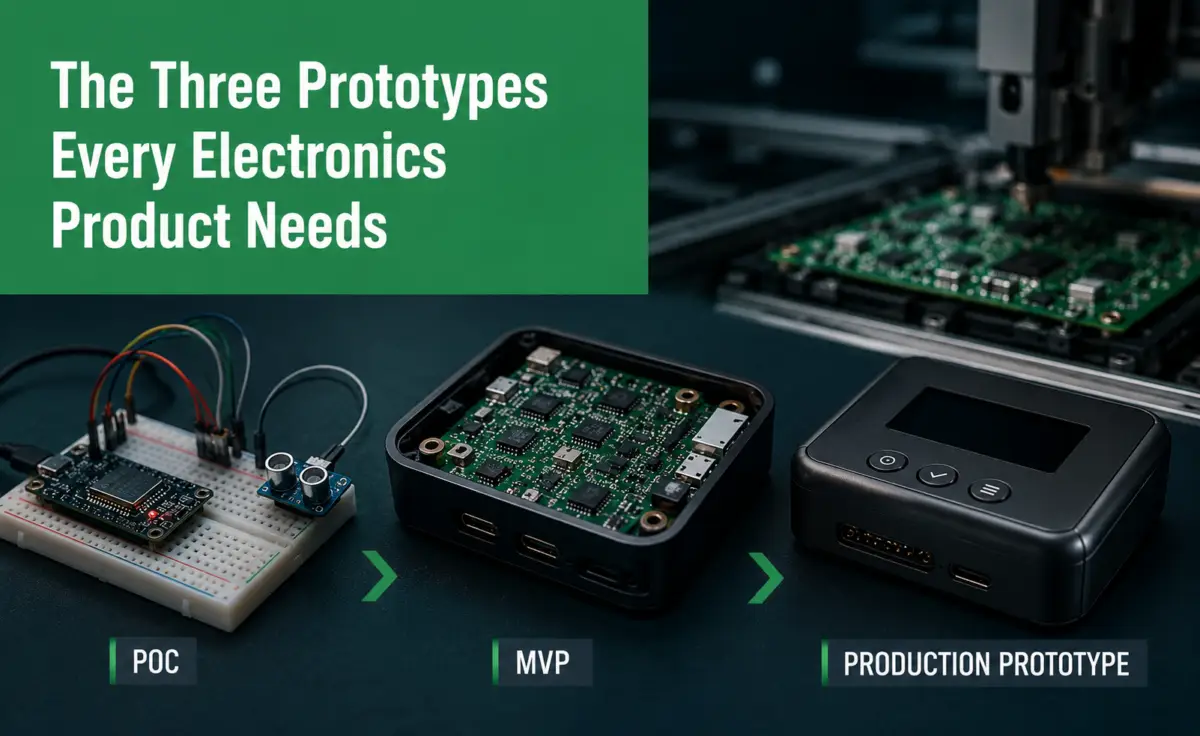
Most electronics products fail between concept and production, not because the underlying technology doesn't work, but because the development process collapses the distinct validation goals of each stage into a single, blurry "build a prototype" phase.
There is a reason hardware development follows a structured sequence. Each prototype is not just an iteration: it is an answer to a specific question. Confusing those questions is one of the most reliable ways to burn development budget and delay a launch. The teams that navigate this well understand that a proof of concept, an MVP, and a production prototype are fundamentally different instruments, each suited to a different job.
This post walks through the three core hardware prototypes, what each one is supposed to prove, and what lifecycle management looks like after a product reaches the market.
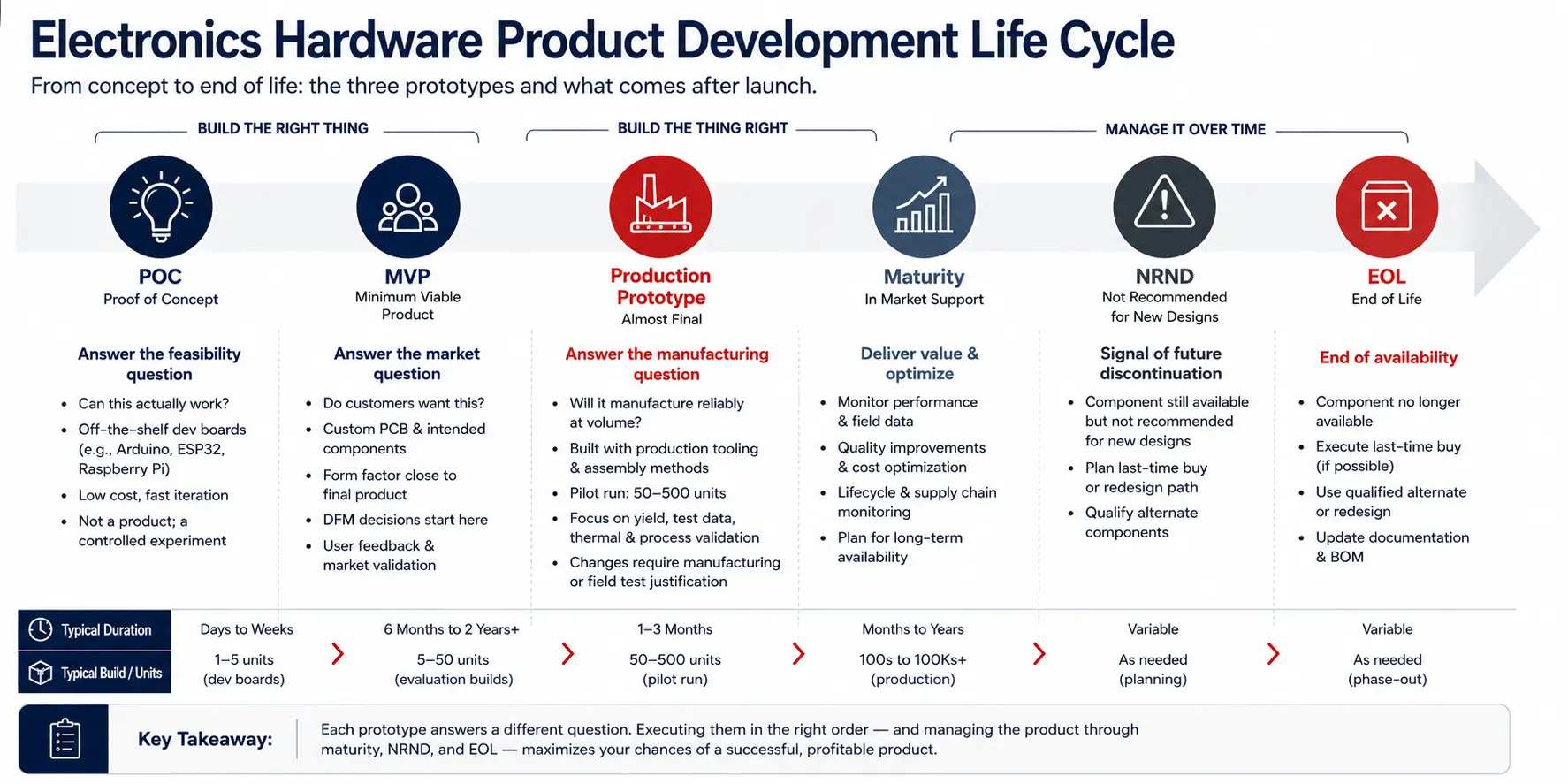
The Proof of Concept: Answering the Feasibility Question
The proof of concept exists to answer one question: can this actually work? It is the cheapest and fastest way to validate a core technical assumption before investing in custom design work.
POC hardware typically relies on readily available development platforms: an ESP32 development board, a Raspberry Pi, an Arduino with a sensor module. The BOM is almost entirely off-the-shelf. The physical package bears no resemblance to the intended product. That is deliberate.[1] A POC is not a product and should not be treated as one. It is a controlled experiment.
The conclusions a POC produces are binary: the physics works, or it doesn't. The control algorithm is achievable, or it requires a different approach. A well-scoped POC takes days to weeks, costs relatively little, and protects a team from committing serious resources to a flawed architecture. What it cannot tell you is whether the design will be manufacturable, thermally stable at volume, or cost-effective when assembled on production lines. Those questions belong to the next phase.
The MVP: From Function to Form
The minimum viable product is the first prototype built with intended production components and a form factor close to the real product. Its question is different: do customers actually want this?
Where a POC is a technical exercise, an MVP is a market validation instrument. It should look and behave closely enough to a real product to be placed in front of actual users and generate actionable feedback.[2] That means custom PCB layout, intended component selection, and a housing that approximates the production version, not a cobbled-together evaluation kit in a project box.
MVP development is where DFM decisions begin to matter. Component footprints, thermal management, connector placement, and board stackup all affect manufacturing yield and repairability. Teams that treat the MVP as a purely functional exercise and defer DFM to a later stage frequently discover expensive layout problems at the worst possible moment: when the design is otherwise locked. A contract manufacturer reviewing an MVP design before it is finalized can flag pad geometries that won't hold solder paste through reflow, copper pours that create warping risk, or BOM items with known supply chain constraints. That review at the MVP stage costs a fraction of what a rework cycle costs after the design has been committed.
Development timelines from POC to validated MVP vary considerably. Products without certification requirements often complete this phase in 6 months to 2 years.[3] Products requiring FCC, CE, or UL certification typically take longer, and the more complex the regulatory path, the earlier the certification engineering needs to begin.
The Production Prototype: Almost Final
The production prototype is the design that will ship, minus the changes that come back from manufacturing runs and early field testing.
At this stage, the design is built using production tooling and assembly methods, typically in a pilot run of 50 to 500 units.[4] The primary purpose is no longer to validate function: the design has already answered that question. The goal is to confirm that the product can be manufactured consistently, at acceptable yield, using the processes and materials that will be in place at full volume.
The outputs are process-oriented: solder defect rates by board region, test failure patterns pointing to layout or component issues, and thermal behavior under production reflow profiles that may differ meaningfully from hand-assembly results. Process engineers, not just design engineers, are the primary audience.
One discipline that separates strong production prototype runs from weak ones is restraint. Changes introduced at this stage for convenience, preference, or aesthetics create risk without proportionate benefit. The standing rule is simple: changes require a manufacturing or field test justification. Everything else waits until the next product revision.
After Launch: Maturity, NRND, and End of Life
A product that reaches the market successfully enters a phase of lifecycle management that most development teams underestimate until they face it directly.
Electronic components follow their own lifecycle, independent of the products they serve: introduction, growth, maturity, decline, phase-out, and obsolescence. Component lifecycles have compressed dramatically in recent decades, dropping from roughly 30 years to under 4 years for many parts.[5] Around 37% of components reach end-of-life status without formal advance notice from the manufacturer.[6] Most teams encounter the consequences on a production line, not in advance.
The first formal signal is typically an NRND designation: Not Recommended for New Designs. A component carrying this status is still available but the manufacturer is signaling that production will not continue indefinitely. When a formal EOL notice arrives, the options are narrow: execute a last-time buy, qualify a form-fit-function alternate component, or redesign the affected portion of the board.[7]
The teams that handle this phase well are the ones that built approved alternates into the BOM at the production prototype stage. The teams that struggle are the ones who shipped on a single-source component with no qualified substitute and are now facing a redesign under schedule pressure.
At Circuits Central, we work with teams across every stage of this lifecycle: reviewing POC concepts for technical feasibility, running DFM checks on MVP layouts before they are finalized, executing production prototype builds, and managing the manufacturing implications of component changes after launch. If you are navigating a transition between these stages, our PCB assembly page is a practical starting point. Learn more about our PCB assembly services → https://www.circuits-central.com/services-capabilities/printed-circuit-board-assembly-pcba/
"Your first prototype is a question. Your production prototype is the answer. Everything in between is the work of figuring out which question you actually needed to ask."
Sources
-
"Overview of Hardware Product Development Stages: POC, EVT, DVT, PVT" — Encata↩︎
-
"Overview of Hardware Product Development Stages: POC, EVT, DVT, PVT" — Encata ("Hardware MVP is a prototype which can be presented/sold to real customers to gather valuable product feedback")↩︎
-
"The Complete Guide to Hardware Product Development" — MistyWest (development timeline guidance: 6 months to 2 years for products without extensive certifications)↩︎
-
"Overview of Hardware Product Development Stages: POC, EVT, DVT, PVT" — Encata (PVT phase: 50–500 units using production tooling)↩︎
-
"Guide to Electronics Component Lifecycle and Obsolescence Management" — Luminovo (component lifecycle compression from approximately 30 years to under 4 years)↩︎
-
"Guide to Electronics Component Lifecycle and Obsolescence Management" — Luminovo ("37% of parts become obsolete without warning")↩︎
-
"Managing Component Obsolescence" — Altium (EOL response options: last-time buy, qualified alternate, redesign)↩︎


