
Circuits Central Joins the Kickstarter Partner Program: A New Path for Hardware Creators
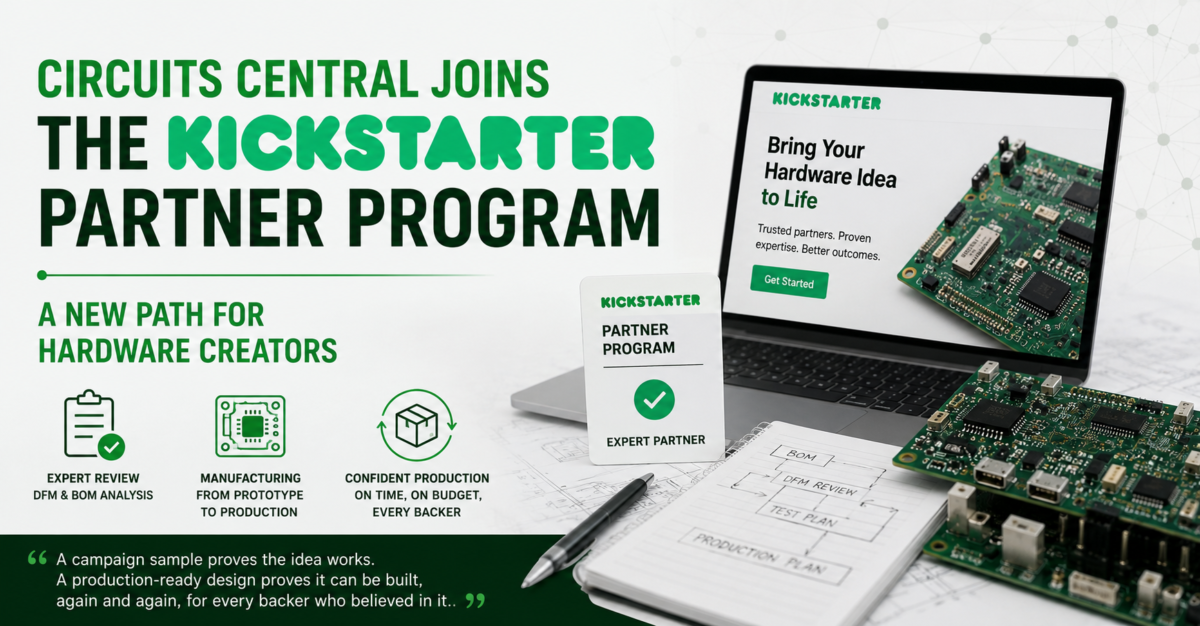
Circuits Central has been accepted into the Kickstarter Partner Program[1] as an Expert Partner and trusted service provider for hardware creators. This is a meaningful milestone for our team, and we are excited to support creators who are turning great hardware ideas into real, manufacturable products.
The Kickstarter Partner Program connects creators with experienced specialists across the product development journey, from design and prototyping through manufacturing and fulfillment. Being included as an Expert Partner reflects the manufacturing depth our team has built supporting electronics products from early prototype through post-campaign production.
For hardware creators, this kind of support has always mattered. A 2015 University of Pennsylvania study of 47,188 funded Kickstarter campaigns found that about 9% failed to deliver rewards to backers[2]. For electronics campaigns, the rate is higher, and the failure mode is almost always the same. It is not a bad idea, weak marketing, or a funding shortfall. It is manufacturing complexity that was not accounted for before launch. The partner program is Kickstarter's answer to that pattern: give creators access to specialists earlier, while there is still time to act on what they learn.
What an Expert Partner Brings to a Hardware Campaign
The most valuable moment in a hardware campaign for a manufacturing review is before the campaign page goes live. That is when every important decision is still open: pricing, reward tiers, delivery timelines, production quantities, the product design shown in campaign photos. Working through the manufacturing picture before launch means those decisions can be made with real information.
A 2024 DTU Science Park analysis of 25 large crowdfunded hardware projects found combined losses exceeding $26 million across those campaigns.[2-1] The patterns behind those outcomes are well understood and largely preventable. Kickstarter's partner program reflects that: connecting creators with experienced manufacturing support earlier in the process is how those patterns get interrupted.
The areas where pre-launch review delivers the most value:
- BOM completeness and sourcing strength. A complete BOM means every component is specified by manufacturer part number, approved alternates are identified, and any single-source or long-lead parts are flagged before they become a schedule problem. A campaign that locks in a delivery date without a sourced BOM is building a schedule on assumptions.
- PCB layout and DFM review. Footprint accuracy, paste aperture sizing, test-point placement, silkscreen clearance, and assembly drawing completeness all determine whether a board can be assembled reliably at production volumes. DFM issues found before launch are straightforward to address. Found after funding, they become engineering changes under schedule pressure.
- Test and bring-up planning. How will boards be tested at scale? Is there a functional test plan, firmware loading requirements, or first article inspection criteria? These are decisions that benefit from being made before quantities are committed, not after.
- Production quantities and lead times. The volumes implied by reward tiers set the production run size, which drives MOQ requirements, panel yield, component pricing, and realistic lead times. A campaign targeting 300 backers and a 90-day delivery window needs a production plan in place before launch.
From Campaign Sample to Confident Production
Campaign samples serve a specific purpose: they demonstrate the product to backers, press, and reviewers. They are not production units, and building them does not validate the production process. The transition from a great campaign sample to a repeatable production build is where experienced manufacturing support makes the biggest difference.
Documented case studies illustrate why this transition is worth planning for. Triggertrap's Ada campaign saw electronics and software costs grow to roughly ten times the original budget [2-2]. The CST-01 watch reached a stage where only about half of production units passed quality acceptance. Both teams had working prototypes that demonstrated a real product. Both ran into the same gap between bench-built samples and repeatable volume production. That gap is exactly what experienced manufacturing support is designed to close, and closing it before launch is always easier than closing it after.
The transition from campaign to production involves decisions that are independent of whether the campaign funds: sourcing strategy (consigned versus turnkey, authorized distributors versus spot buys), inspection criteria (IPC class, first article acceptance), revision handling, and packaging assumptions. In 2026, cross-border sourcing adds an additional layer. Changing de minimis rules, shifting duty rates, and component lead time volatility have made early-campaign cost assumptions unreliable by the time production begins. Building sourcing flexibility into the design (approved alternates, multiple-source components, documented substitution criteria) is the kind of structural decision that is straightforward to make before launch and difficult to make under production pressure.
Where Circuits Central Fits
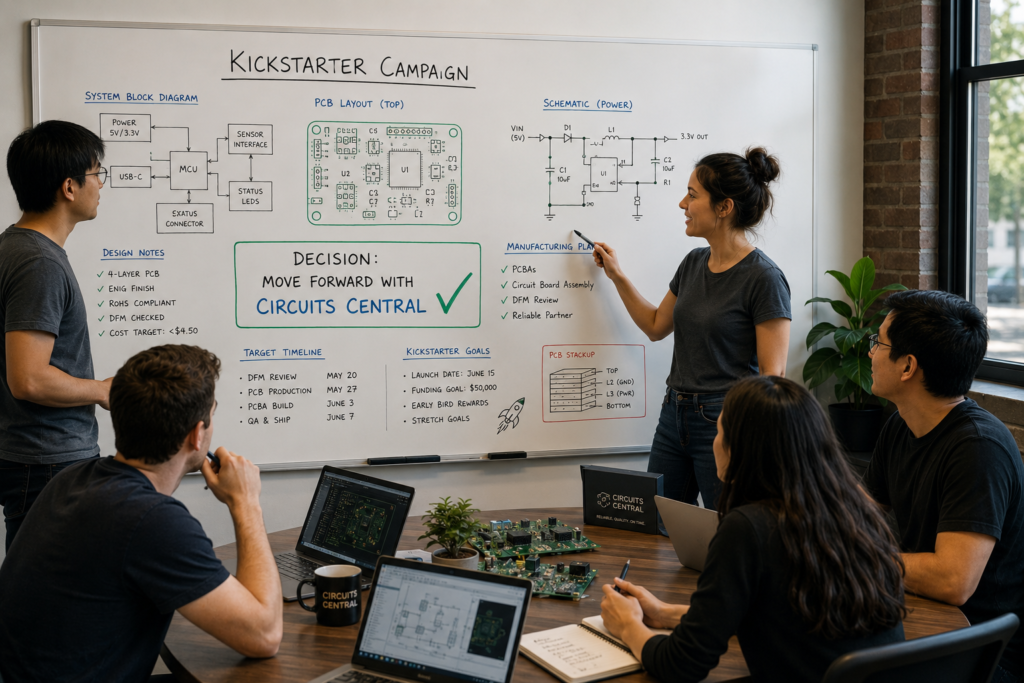
Circuits Central has joined the Kickstarter Partner Program as an Expert Partner and trusted service provider for hardware creators. We offer a free, no-obligation consultation and DFM review for Kickstarter creators at any campaign stage, from early prototype through post-funding production planning.
The review covers design files, BOM, sourcing risk, test planning, and production assumptions. It is designed to surface the questions that are straightforward to answer before launch and expensive to answer after. For North American creators, working with a Canadian partner can also simplify cross-border communication, documentation, and sourcing without adding logistics complexity.
Learn more about our Kickstarter Expert Partner program at https://www.circuits-central.com/solutions/kickstarter-expert/.
Kickstarter is a trademark of Kickstarter, PBC. Circuits Central is an independent electronics manufacturer accepted into the Kickstarter Partner Program as an Expert Partner.
"A campaign sample proves the idea works. A production-ready design proves it can be built, again and again, for every backer who believed in it."
Sources
-
Kickstarter, "Introducing Kickstarter's New Partner Program" — Kickstarter Blog, 2026-02-24↩︎
-
DTU Science Park, "26 Million Lost: Why Crowdfunded Hardware Projects Fail" — DTU Science Park, 2024↩︎↩︎↩︎


