
5 Common Prototyping Mistakes That Can Delay Your Product Launch
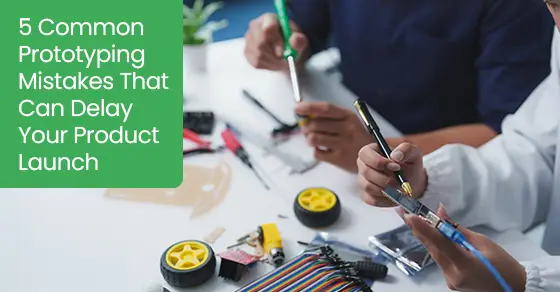
Prototypes are supposed to reveal issues before they become expensive production problems. At Circuits Central, we see how much smoother development becomes when testing is planned early, measured clearly, and tied to the risks that actually matter for the product.
A prototype that powers on is not automatically ready for production. It may still have integration issues, workmanship concerns, firmware inconsistencies, thermal weaknesses, or test access limitations that only appear under the right conditions.
Our testing process is built to help product teams find those issues earlier. Weak or skipped prototype testing can turn small prototype problems into redesigns, rework, missed launch targets, and avoidable production delays.
How Prototype Testing Helps Prevent Product Delays
Prototype testing helps confirm whether a board or assembly performs as intended before your team commits to production planning. Strong testing turns assemblies into dependable products by making workmanship measurable, catching early failures, and defining repeatable pass/fail criteria instead of relying on informal knowledge or assumptions.
The best test strategy depends on the product. A startup preparing an early hardware build may need flexible testing and fast feedback. An NPI team moving toward production may need controlled procedures, documented results, and a clear path for scaling test coverage across revisions.
Here are five common mistakes that can slow down a launch.
1. Skipping Prototype Testing Until Problems Appear
Testing often gets pushed aside when a prototype looks clean, powers on, or passes a basic inspection. That confidence can disappear quickly during system integration, especially when the board behaves differently under load, firmware changes, or real operating conditions.
Late testing reveals issues after schedules, budgets, and launch expectations are already set. At that point, even a manageable defect can affect purchasing, production planning, customer commitments, and engineering resources.
A board may pass visual inspection but fail when connected to the full system. The issue might be a signal path problem, an intermittent connection, or a functional condition that was never checked during early bring-up. Prototype problems are usually easier to fix before production planning begins.
We support product-specific testing strategies that go beyond generic inspection. Performance, workmanship, function, and risk areas can all be validated in a way that fits the product and its intended use.
2. Failing to Define Clear Pass/Fail Criteria
A test that produces unclear results does not give your team much confidence. One engineer may say the prototype “seems fine,” while another sees a result that falls short of what the product needs for production, reliability, or customer use.
A major testing challenge is turning functional requirements into a clear definition of “pass.” Ambiguous criteria create ambiguous results. Before your team relies on test outcomes, the checks should be measurable and tied to the product revision.
| Weak Testing Standard | Better Testing Standard |
|---|---|
| Board turns on | Board powers on within defined voltage and current limits |
| Firmware loads | Firmware loads consistently under the required setup |
| Unit works | Unit passes defined functional checks under expected operating conditions |
Clear standards make results easier to compare across builds. They also help your team decide whether a design is ready to move forward or needs another revision.
3. Ignoring Design for Test During Layout
Some prototype problems start before the first board is assembled. If test access is not considered during layout, your team may discover too late that key signals are hard to reach, programming access is awkward, or a fixture would require unnecessary complexity.
Retrofitting test access after layout can force compromises. Dense boards may benefit from early planning around test pads, connector access, programming headers, or JTAG and boundary scan where supported.
Design decisions that help testing include:
- Reserving practical test points for key signals
- Keeping programming headers consistent and accessible
- Planning connector access before the enclosure creates limits
- Considering JTAG or boundary scan for dense digital assemblies
Good design-for-test planning can reduce bring-up time and make future testing easier to repeat.
4. Choosing the Wrong Test Method for the Prototype Stage
Not every test method fits every stage. A prototype may need flexible testing that can adapt as the design changes. A stable, higher-volume build may justify a fixture-based approach.
Flying probe testing can suit prototypes and low-volume builds because it does not require a dedicated fixture. ICT may make more sense once the design is stable and volume supports the fixture cost. Functional testing checks end-to-end behaviour, firmware, and integration, while AOI and X-ray can detect assembly issues, including hidden solder joint concerns under certain packages.
| Test Method | How It Helps During Development |
|---|---|
| AOI | Checks visible assembly defects and placement issues |
| X-Ray | Reviews hidden solder joints under packages like BGAs and QFNs |
| Flying Probe | Supports flexible testing for prototypes and low-volume builds |
| Functional Test | Confirms the assembly performs intended functions |
| ESS / Burn-In | Helps expose early-life or temperature-related weaknesses |
Test coverage should match product risk, not habit or guesswork.
5. Treating Test Documentation as an Afterthought
Undocumented testing creates confusion as soon as the product changes. Without test logs, pass/fail summaries, and defect notes, teams may struggle to compare results between revisions or understand whether a design change fixed the issue.
Procedures should be tied to product revisions. Documentation reduces reliance on individual memory and makes it easier to move from prototype to production with fewer repeated investigations.
Useful documentation may include the revision number, test setup, pass/fail thresholds, defect notes, and next actions. Product delays can happen when your team has to rediscover old issues instead of building from a clear test history.
Why Prototype Problems Turn Into Product Delays
Prototype problems rarely stay isolated when they are found late. A hidden defect can trigger redesign work, another PCB revision, added sourcing, firmware changes, fixture updates, re-testing, or delayed production readiness.
| Prototype Problem | Possible Delay |
|---|---|
| Hidden solder issue | Rework and added inspection |
| Poor test access | Slower debugging and validation |
| Undefined pass/fail criteria | Repeated testing and unclear decisions |
| Thermal weakness | Reliability review before launch |
| Inconsistent documentation | Confusion between revisions |
Late discoveries affect more than engineering. Purchasing may need revised parts, manufacturing may need new instructions, and customer timelines may need to shift. Early testing gives your team better information before decisions become expensive to change.
How We Support Smarter Prototype Testing
We help teams move from prototype uncertainty toward a controlled testing process. The right mix depends on the product’s risk profile, volume, design stability, and likely failure modes.
Our post-manufacturing testing and development support can include AOI, X-ray, functional testing, JTAG and boundary scan, flying probe testing, ICT, ESS, burn-in, thermal cycling, and test development workflows. Through our post-manufacturing testing and development services, we help define product-specific risks, choose measurable criteria, confirm test access, validate procedures on early builds, and document testing across revisions.
That structure helps your team scale from prototype to production without depending on guesswork.
Reduce Product Delays With Better Prototype Testing
Better prototype testing gives your team a clearer path from early builds to production by catching prototype problems before they become expensive product delays. We can help define, implement, and document testing strategies that fit the product’s actual risks.
When you need a clearer testing strategy before launch, we can help you move forward with more confidence.
Reach out to Circuits Central today at 1-(888)-821-7746, email us at info@circuits-central.com or click here to get in touch online.
FAQs About Prototype Testing
What Is Prototype Testing?
Prototype testing checks whether an early version of a product or assembly performs as intended before full production. It can include inspection, electrical testing, functional testing, reliability screening, and documentation.
How Can Prototype Testing Prevent Product Delays?
Early testing can reveal design, assembly, access, firmware, or reliability issues before they disrupt production planning. Finding those issues sooner helps reduce product delays, rework, and unclear launch decisions.
What Are Common Prototype Problems?
Common prototype problems include unclear pass/fail criteria, poor test access, hidden assembly defects, functional failures, thermal issues, and inconsistent documentation. These issues can become harder to resolve when they are discovered late.
When Should Prototype Testing Be Planned?
Testing should be considered during design and layout, especially when test points, connector access, programming headers, or boundary scan may be needed. Early planning can reduce bring-up time and make testing easier to repeat.
Does Every Prototype Need The Same Test Method?
No. Test coverage should match the product’s risk, stage, volume, and design stability. Prototypes and low-volume builds may need flexible methods, while stable production runs may justify fixture-based testing.
.over-blog{ overflow-y: scroll; }


