
Why DFM Reviews Are Critical Before PCB Production
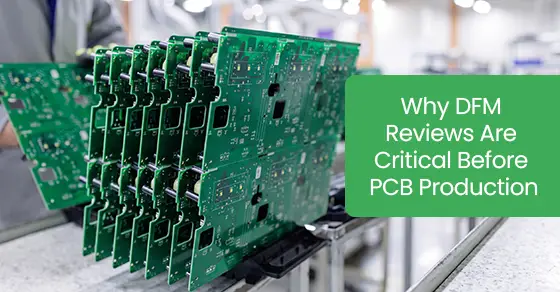
Design for Manufacturability, or DFM, is the process of reviewing a PCB design to confirm it can be built efficiently, consistently, and with fewer surprises once it reaches production. In practical terms, it helps catch layout and fabrication issues before they become expensive manufacturing problems. For engineers, product designers, and procurement teams, that review can be the difference between a smooth launch and a project slowed down by redesigns, scrap, or missed timelines.
Skipping that step often pushes preventable problems into fabrication or assembly, where fixes cost more and take longer. A design may look complete on screen while still carrying issues such as spacing violations, unsuitable drill sizes, weak thermal choices, or data that creates confusion on the shop floor. In this article, we’ll break down why DFM for PCB matters before production and how it affects cost, speed, quality, and overall manufacturing success.
The Importance of DFM for PCB in Manufacturing Success
A strong manufacturing outcome rarely comes from design work alone. It depends on whether the design can move cleanly into fabrication and assembly without creating unnecessary friction. That is where DFM for PCB plays a central role.
DFM connects design intent with production reality. It gives design teams and manufacturing teams a shared framework for spotting issues early, clarifying tolerances, and aligning decisions before material is ordered or boards are built. Instead of treating manufacturability as a final checkpoint, the review works best as an early validation step that supports faster decisions later.
Reduces Manufacturing Errors
Many PCB problems begin with details that seem minor during design but cause major trouble in production. Clearance violations, trace widths that do not support current demands, drill sizes outside process capability, solder mask slivers, and annular ring issues are all common examples. A DFM review brings those risks forward before they affect fabrication.
Catching these errors early helps prevent defective boards, failed electrical testing, and unnecessary rework. A via too close to a pad can create soldering problems. A trace that is too narrow may overheat in use. A drill callout that does not match available tooling can stop production until the file is corrected. None of those issues is convenient to solve after a job has already been released.
Lowers Production Costs
Design flaws do not just create technical issues. They also drive up costs at multiple stages. Fabrication problems can lead to scrap. Assembly problems can trigger manual intervention. Prototype failures can force another round of revisions, new material purchases, and more engineering time.
A good DFM process reduces those avoidable costs by improving the chances of first-pass success. When the design is better matched to manufacturing capabilities, there is less waste, fewer change orders, and less money spent correcting problems that could have been identified earlier. For procurement teams in particular, that kind of predictability matters because it makes budgeting and supplier coordination far easier.
Improves Production Efficiency
Clean, manufacturing-ready design data helps the entire production flow move with less friction. Fabricators can interpret files more quickly, tooling decisions become more straightforward, and assembly teams are less likely to stop for clarification. That efficiency has a direct effect on turnaround time.
Production also runs more smoothly when the design has already accounted for manufacturability constraints. Better panel usage, clearer drill data, practical spacing, and well-prepared documentation all help reduce delays inside the build cycle. In a busy production environment, fewer questions and fewer exceptions often translate into faster delivery.
Enhances Product Reliability
Manufacturability and reliability are closely connected. A board that is difficult to build consistently is also more likely to show variation in performance or durability once it is in use. DFM reviews help reduce that risk by identifying design choices that could weaken long-term results.
Thermal management is one example. Copper balance, trace sizing, and component placement can all affect heat handling. Signal integrity is another. Stack-up choices, routing decisions, and impedance-sensitive areas may need closer review before production starts. DFM does not replace full electrical validation, but it helps confirm that the board can be manufactured in a way that supports reliable field performance.
Prevents Production Delays
Late-stage design issues are one of the fastest ways to lose time in a PCB project. When a manufacturability problem appears after release, production may pause while the design team updates files, answers questions, or reworks the layout. That back-and-forth can affect prototype schedules, purchasing timelines, and customer commitments.
Reviewing manufacturability before production helps reduce those interruptions. Instead of reacting to problems after the job is already moving, teams can address them while revisions are still manageable. The result is a more predictable production schedule and a shorter path to market.
When to Perform a DFM Review in the PCB Design Process
The best time to review manufacturability is not just once at the end. Early reviews during pre-layout planning can help shape stack-up choices, spacing assumptions, and fabrication strategy before design work becomes harder to change. A post-layout review then checks whether the finished design aligns with manufacturing limits and assembly needs. A final pre-production review adds one more layer of protection before release.
Using more than one review stage improves outcomes because different risks appear at different points in the design cycle. Early collaboration between designers and manufacturers also leads to better decisions, especially when the product has tighter tolerances, higher complexity, or demanding reliability requirements.
What Happens Without DFM for PCB Before Production
Without a DFM review, problems tend to surface at the worst possible moment. A prototype may fail because of a preventable layout issue. Production may stop because a drill file or stack-up decision needs revision. Delivery dates may slip while teams work through redesign cycles that should have been avoided.
The financial cost is only part of the damage. Repeated errors can strain supplier relationships, create internal schedule pressure, and weaken confidence in the product development process. Reactive fixes are almost always more expensive than proactive validation, particularly when multiple stakeholders are waiting on the same build.
How DFM for PCB Improves Production Outcomes
DFM for PCB gives manufacturers cleaner data, gives design teams earlier visibility into risks, and gives procurement teams more predictable costs and timelines. That combination leads to stronger production outcomes, fewer avoidable setbacks, and a smoother path from design release to finished board. At Circuits Central, we support that process by helping customers prepare designs for efficient, reliable PCB manufacturing.
Reach out to Circuits Central today at 1-(888)-821-7746, email us at info@circuits-central.com or click here to get in touch online.
FAQ
What Is DFM for PCB?
DFM for PCB means reviewing a board design to confirm it can be fabricated and assembled using real manufacturing capabilities and process limits. It helps prepare the design for production by checking whether layout choices, materials, dimensions, and documentation support a smoother build.
When Should a DFM Review Be Conducted?
A DFM review is most useful when it happens more than once. Early checks during planning and layout can catch design assumptions before they become locked in, while post-layout and pre-production reviews help confirm the finished design is ready for manufacturing.
Can DFM Eliminate All PCB Issues?
No. DFM reduces risk, but it cannot eliminate every possible issue in a PCB project. Electrical performance, component availability, application conditions, and testing outcomes can still affect results. What DFM does very well is reduce manufacturability-related problems before they become more costly.
How Does DFM Impact PCB Costs?
DFM helps control cost by reducing scrap, rework, production delays, and repeated prototype cycles. A design that is aligned with manufacturing capabilities is more likely to move through fabrication and assembly with fewer corrections, which lowers both direct production costs and internal project overhead.


