
Turnkey vs. Consignment: How Your Assembly Model Shapes What You Pay
A PCB assembly quote arrives with more line items than most engineers expect. There is a setup charge, a component cost, an assembly fee, and sometimes a stencil cost listed separately. The total looks reasonable or alarming depending on context, but the individual lines rarely explain themselves. Understanding what each number represents, and why the same board can produce very different totals depending on how a job is structured, is the clearest way to evaluate your options.
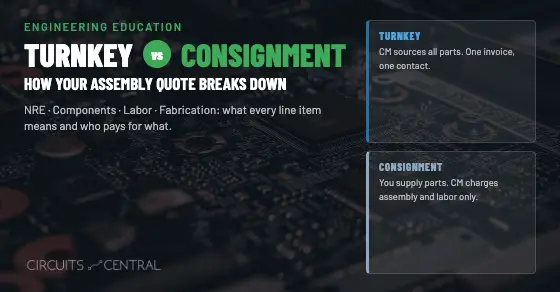
The two primary procurement models for PCB assembly, turnkey and consignment, produce quotes that look structurally different from each other. That difference goes deeper than who orders the resistors.
What a Quote Actually Covers
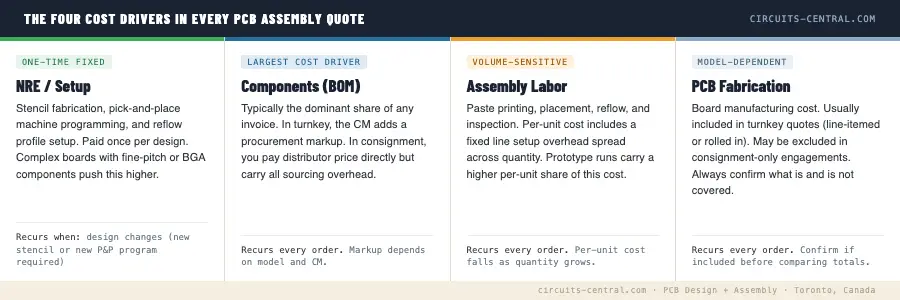
Every PCB assembly quote reflects the same underlying costs, regardless of who wrote it:
- Non-recurring engineering (NRE): The one-time cost of preparing your design for production. This covers stencil fabrication, pick-and-place machine programming, and reflow profile setup. For standard SMT boards, NRE typically falls in the low hundreds of dollars. Complex designs with fine-pitch or BGA components, or those requiring dedicated test fixtures, can push it substantially higher.
- Component cost: The BOM. This is typically the largest single cost driver. Altium, which works with hardware teams across a wide range of production environments, notes that components represent "a major cost driver for a finished PCB" and that assembly costs at low volumes "can even exceed fabrication."[1]
- Assembly labor: The time charged for paste printing, placement, reflow, and inspection. Per-unit labor cost falls sharply with volume. The fixed overhead of running any SMT line (machine setup, solder paste management, conveyor calibration) is the same whether you are building five boards or five hundred. As quantity increases, that overhead is spread across more units.[2]
- PCB fabrication: If included in the quote, the board cost is either line-itemed separately or folded into the per-unit price. This is common in turnkey packages.
NRE is a fixed cost. At low quantities, it has an outsized effect on the per-unit total. The same setup fee that adds $40 per board at five units adds less than a dollar at 500. This is why per-unit cost drops sharply as quantities increase, and why small prototype runs look expensive relative to their apparent complexity.
What Turnkey Means for Your Invoice
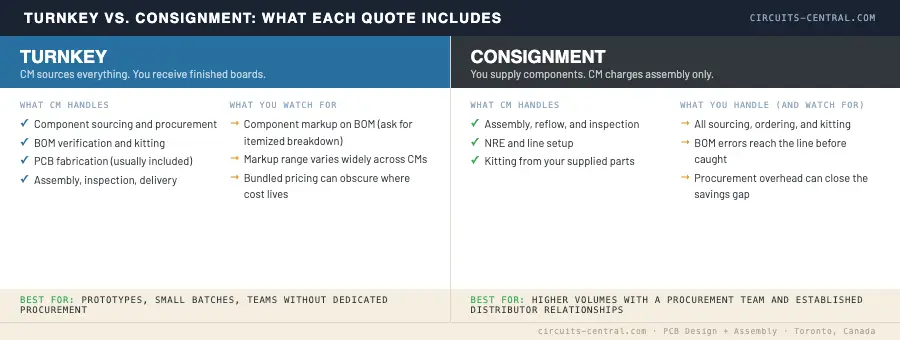
In a fully turnkey engagement, the CM handles everything: board fabrication, component sourcing, kitting, assembly, inspection, and delivery. You provide Gerbers, BOM, and requirements. The quote you receive bundles all of those inputs.
The tradeoff is component markup. CMs who source on your behalf add a procurement and inventory management fee to the component cost. This markup varies widely across the industry. In our experience, responsible CMs charge a modest margin that reflects genuine procurement effort. Altium observes that markups from some assemblers can significantly exceed what buyers expect, and notes having seen "markups exceeding 100% from some assemblers."[3] That range is wide precisely because there is no standard. Asking your CM to show component cost versus markup as separate line items is a reasonable and direct way to benchmark what you are actually paying for.
The apparent price premium of turnkey often narrows when the full cost of the alternative is accounted for.
What Consignment Actually Costs
Consignment assembly means you supply the components and the CM charges only for labor, machines, and expertise. Your quote reflects assembly cost alone, and your component cost is whatever you paid directly to distributors.
On paper, this looks like a straightforward savings. You avoid the CM's markup entirely, and an initial comparison against turnkey can suggest a meaningful price gap. That comparison rarely captures the full cost of running a BOM yourself.
Procurement is not passive. For a 100-unit build with many unique components, sourcing, ordering, verifying, kitting, and shipping all parts to the CM takes real internal time. For smaller teams without dedicated procurement staff, this overhead can close the apparent cost gap quickly. For larger teams with established distributor relationships and ERP-driven purchasing, consignment scales much better, and the economics shift in its favor at higher volumes.
The other factor is risk at the assembly line. In consignment, every component arrives from your side of the relationship. If a part is wrong, missing, or incorrectly specified, it arrives with the kit. In turnkey, those discrepancies are caught before kitting begins. BOM errors reaching the assembly floor are among the most common causes of first-article failures and line stoppages in consigned builds, not because consignment is inherently unreliable, but because the CM has no opportunity to vet incoming parts before they are placed.
The right answer depends on your volume, procurement infrastructure, and tolerance for managing the sourcing side of a build.
What Pushes Quotes Higher Than Expected
Two quotes for identical boards can look very different. Several factors explain the gap:
- Rush fees: Expedited turnaround adds meaningfully to labor cost. Planning your timeline to avoid express builds is one of the fastest ways to reduce total assembly spend.
- Double-sided assembly: A second reflow pass requires a separate stencil, a separate placement program, and additional handling time. Each generates its own cost line, and the increase is not trivial.
- Component availability: Extended lead times on certain categories create sourcing decisions with real cost implications. A CM with distributor relationships and stocked inventory absorbs that friction differently than one without it.
- Inspection requirements: BGA and fine-pitch components require X-ray or 3D AOI inspection at any volume. These are not negotiable line items if the components are in your BOM.
- Test scope: Functional testing billed by the hour adds cost that varies considerably depending on how complex the test sequence is and how well the fixture is designed.
None of these are hidden in a well-structured quote. They reflect genuine constraints on running a production line. The most common source of quote surprises is not dishonest pricing; it is a BOM or design that has requirements the initial scope did not anticipate.
How to Read Quotes Side by Side
At Circuits Central, we offer both turnkey and consignment assembly, and we structure quotes to make the cost breakdown explicit. If you are evaluating multiple quotes and the totals diverge, ask each CM to separate NRE, component cost, assembly labor, and test. A quote that bundles all of those into a single per-unit number may not be hiding anything, but it makes comparison difficult. Transparency at the quote stage is a reasonable proxy for transparency throughout the build. Learn more about our assembly services and how we approach quoting at circuits-central.com.
"The cheapest quote is not always the cheapest build. The difference usually lives in the line items that were not shown."
Sources
-
"PCB Cost Drivers and Designing to Cost" - Altium, updated September 29, 2025↩︎
-
"PCB Cost Drivers and Designing to Cost" - Altium, updated September 29, 2025↩︎
-
"PCB Cost Drivers and Designing to Cost" - Altium, updated September 29, 2025↩︎


