
Materials Matter: How to Choose the Right Substrates for Your PCB
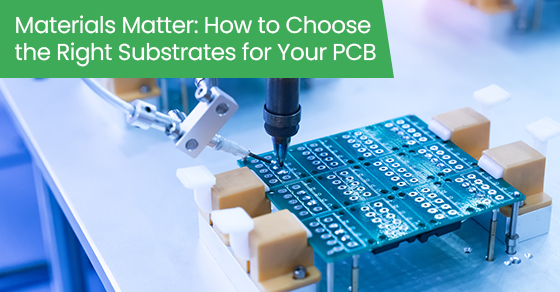
Just as the key to a home’s longevity is a strong and stable foundation, the key to a sturdy and durable printed circuit board (PCB) is a good substrate. Therefore, in order to manufacture a high-quality and reliable PCB, the most critical first step is deciding on the most appropriate substrate materials.
Circuit boards have countless minuscule parts and components. Thus, they require a canvas or platform to keep them all together, which is where the substrate comes in.
In order to serve their function, substrates must be made from non-conductive dielectric materials that are able to withstand a great deal of heat, as PCBs often generate such heat when they are in use.
In addition, a PCB’s substrate acts as an insulator, delivering electric insulation between other conductive materials, and must thus be made of a material that allows it to fulfill this role.
When PCB substrate materials vary, this allows for different additional functions and capabilities that may be needed based on the particulars of the PCB’s design and its applications.
What are the different classifications of PCB substrate materials, and what are some commonly used materials that fall into these categories?
Generally, there are two primary categories of PCB substrate materials: rigid substrate and flexible substrate materials. There are a few key differences between these categories of materials. The category best suited for a particular PCB depends on various factors.
The following are some of the main differences between rigid and flexible PCB substrates, as well as some of the most common materials that tend to be used in each of these categories:
Rigid PCB Substrates
The most common substrate material used to form a rigid PCB is copper-clad laminate (CCL), a reinforced material. To prepare this laminate, it must first be dried and cut into its required size and shape. The pieces must then be laminated into blanks to transform the PCB into a pure insulator without any conducting paths.
After that, a highly conductive and malleable pure copper foil is placed on top and pressed with high temperature and pressure to form the outer layer, which is usually 35-50/ma.
Flexible PCB Substrates
Since not all devices that use PCBs are designed to be flat, it is not always possible to use rigid PCB substrate materials. For devices with irregular shapes and designs, it is necessary to utilize flexible materials to make a PCB that can be folded, bent, or twisted without affecting its conductivity.
Some of the most common flexible materials used to form flexible PCB substrates are polyester film, polyimide film, and fluorinated ethylene propylene film.
What are the most crucial factors to keep in mind when selecting a substrate material for your PCB?
There are a few basic but crucial principles to consider when deciding on the best type of substrate to use for your PCB. These principles mainly relate to the intended purpose of the PCB and where it will be located.
For instance, if your PCB is to be used in a general electronic product with a fairly standard ambient temperature and frequency, then FR-4 is a suitable material option. If, however, your PCB will be used in a high-temperature range, then a high-Tg substrate may be a better option due to its temperature resistance.
A few particularly important factors are especially worth careful consideration before deciding on a specific substrate material to use, which include the following:
1. The glass transition temperature and heat resistance
As you investigate different PCB substrate options, it is important to examine their glass transition temperatures (Tgs). This measures how these materials deal with heat dissipation and ambient temperature.
The most crucial factor here is selecting a material with a higher Tg than the circuit temperature. If you do not, you could risk having the substrate melt or bend when the PCB is in operation.
An alternative option is to use a substrate material that will not easily bend. If the ambient temperature of the device it is installed in causes it to bend, it will wear out quickly, decreasing its longevity.
Thus, especially if the PCB is larger than 3.2 x 1.6 mm and may be exposed to excessive heat, it should have sufficient heat resistance and low bendability.
2. The coefficient of thermal expansion
It is also necessary to learn a substrate material’s coefficient of thermal expansion. It is generally best to find materials with a low coefficient because if they are too high, they will expand more per unit, increasing in temperature. In turn, this will impact the PCB’s length, width, and thickness. As the shape of the PCB shifts, this could damage the board and its components.
3. The dielectric constant and dielectric losses
One more feature that you should definitely look for in your substrate material is a good dielectric constant, as this will help you achieve your desired results by providing better-quality insulation. If your substrate helps prevent dielectric losses, this will also help save energy.
Why You Can Count on Circuits Central to Produce PCBs with High-Quality Substrates
If you would like to get a circuit board design in Toronto and work with experts who will pay close attention to all the factors mentioned above, that is exactly what Circuits Central can offer.
In addition to material procurement, we offer a full spectrum of other electronics and PCB manufacturing services, including consigned or full turnkey manufacturing, assembly, system integration, and post-manufacturing testing.
Therefore, no matter what stage you are at with your PCBs or what you require help with, we have the solutions you need. With an excellent track record stretching back over 25 years, we have the experience necessary to offer a quality of service that is unmatched.
We have worked with a wide spectrum of clients in varying industries, such as communications, medicine, aerospace, and renewable energy, as our highly skilled PCB experts and state-of-the-art manufacturing facility allow us the flexibility to do so.
If you are uncertain about the exact next steps regarding the development of your PCBs, someone from our team would be happy to answer your questions and guide you in the right direction. In addition to being incredibly knowledgeable in this domain, we also pride ourselves on being friendly and easily approachable.
For more information about our approach to circuit board design in Toronto or about the types of PCB materials we can procure for you, call Circuits Central at 1 (888) 602-7264 or contact us here.


