PCB Prototyping vs. Full Production: What Businesses Need to Know
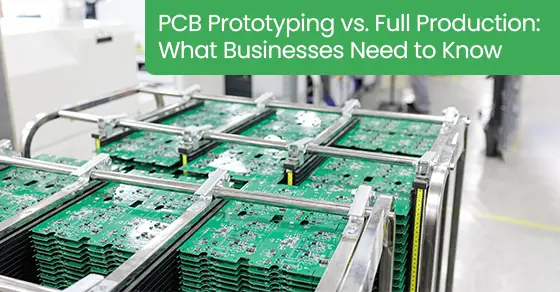
Developing an electronic product involves several stages before it is ready for commercial manufacturing. A business might initially need a handful of printed circuit boards to test a new design, followed by hundreds or thousands of units once the product is finalized. However, successfully testing an individual board is different from establishing a process that can manufacture the same design repeatedly.
Understanding the distinction between PCB prototyping and full production helps businesses make better decisions about development budgets, manufacturing schedules, and product readiness. Each stage has different priorities concerning design flexibility, component sourcing, costs, documentation, and quality control. Recognizing these differences early can help businesses plan the transition from product development to ongoing manufacturing.
PCB Prototyping and Full Production Serve Different Purposes
PCB prototyping and full production both involve manufacturing printed circuit boards, which may then be populated with electronic components. However, the primary objectives differ. Prototyping focuses on evaluating and refining a design, while production focuses on consistently manufacturing an approved design.
The distinction involves more than the number of boards being manufactured.
PCB Prototyping Tests and Refines the Design
PCB prototyping involves manufacturing a limited number of boards to evaluate a design before committing to broader production. Engineers use these early builds to test electrical behaviour, circuit functionality, component placement, physical dimensions, and compatibility with other parts of the product.
Prototypes also allow developers to evaluate firmware, interfaces, and communication between electronic components under practical operating conditions.
For example, a prototype might function correctly during electrical testing but reveal that a connector is positioned incorrectly when installed inside its intended enclosure. Engineers can revise the layout and manufacture another prototype before ordering a larger quantity.
This flexibility makes prototyping valuable for identifying and correcting issues while the design is still evolving.
Full Production Focuses on Consistency and Repeatability
Full production begins when a business is ready to manufacture an approved design repeatedly, using defined specifications, assembly procedures, and acceptance criteria.
Unlike prototyping, where design changes are expected, PCB production emphasizes repeatability. Each manufacturing run must follow the appropriate design revision, component specifications, and quality requirements.
A prototype that performs correctly does not necessarily demonstrate that hundreds of boards can be assembled consistently. Manufacturing equipment settings, component tolerances, documentation, and inspection procedures must also be suitable for repeat builds.
This is why established printed circuit board assembly processes become particularly important as businesses move into regular production.
What Changes Between PCB Prototyping and Full Production?
Although the underlying circuit design may remain similar, the business and manufacturing requirements change as a project progresses. The appropriate approach depends on whether the immediate objective is to validate a product, establish a repeatable manufacturing process, or fulfill ongoing demand.
The following comparison highlights the main differences.
| Comparison Factor | PCB Prototyping | Full Production |
|---|---|---|
| Primary objective | Validate and refine designs | Manufacture approved designs consistently |
| Build quantities | Limited, flexible builds | Planned larger or recurring runs |
| Cost priorities | Development and setup costs | Unit economics and repeatability |
| Turnaround | Timely engineering feedback | Coordinated materials and production schedules |
| Design changes | Frequent revisions | Controlled, documented revisions |
| Quality verification | Design and functional validation | Consistent conformance to specifications |
Build Quantities and Manufacturing Costs
Prototype builds frequently have a higher cost per assembled board because initial engineering and manufacturing expenses are distributed across relatively few units.
These expenses can include assembly programming, stencil preparation, machine setup, component procurement, and engineering reviews. Even when only a few boards are ordered, many preparation activities remain necessary.
During full production, suitable setup costs can be spread across more units. Larger orders may also create opportunities for more efficient material purchasing and production scheduling.
However, manufacturing more boards introduces greater financial exposure if an unresolved design issue is discovered after production begins. A problem affecting an entire production batch can require substantial rework or replacement.
Businesses should therefore evaluate both the initial manufacturing expense and the estimated cost per unit. Board complexity, component pricing, testing requirements, quantities, and expected design revisions all influence the final quotation.
Turnaround Times and Component Availability
Speed is often a priority during PCB prototyping because engineers need assembled boards to continue testing and development. Quick-turn assembly can shorten the time between completing a design revision and evaluating the resulting hardware.
However, expedited assembly depends on several conditions, including component availability, design complexity, manufacturing readiness, and production loading. Actual turnaround must be confirmed during quotation.
Full production generally requires more extensive scheduling around material procurement, assembly capacity, and delivery requirements.
Component availability affects both stages. A bill of materials (BOM) containing obsolete or long-lead components can delay a prototype or disrupt recurring production.
Businesses should identify potential sourcing issues early and establish which substitutions are acceptable.
At Circuits Central, we support different material supply arrangements, including turnkey sourcing, customer-consigned components, and hybrid models. These arrangements allow businesses to determine which party will purchase and supply components for assembly.
Design Changes and Manufacturing Documentation
One of the most significant differences between prototyping and production is how engineering changes are managed.
During prototyping, testing may identify problems involving component footprints, polarity markings, circuit routing, mechanical clearances, or connector placement. These findings often lead to revised designs and additional prototype builds.
Once a design enters production, revisions require more formal control. The approved version must be reflected consistently across fabrication files, assembly instructions, component lists, and placement data.
A complete manufacturing package commonly includes Gerber or other fabrication outputs, a BOM, pick-and-place files, assembly drawings, and applicable testing instructions.
Design for Manufacturing (DFM) reviews help identify potential fabrication and assembly problems before they affect a build. Industry guidance on design for manufacturing requirements provides a technical basis for evaluating relevant design constraints.
Accurate manufacturing data preparation is equally important because conflicting or incomplete files can create uncertainty when transferring designs to manufacturing teams.
For businesses managing PCB manufacturing, maintaining consistent documentation helps reduce misunderstandings and supports controlled revisions across production orders.
Inspection, Testing, and Quality Control
Both prototype and production builds require appropriate quality controls, although the testing objectives may differ.
Prototype testing often concentrates on determining whether a circuit performs its intended functions. Engineers may measure electrical signals, evaluate communication interfaces, or test the board under expected operating conditions.
Production testing must also assess whether manufactured assemblies consistently meet approved specifications.
Different inspection and testing methods serve different purposes:
- First Article Inspection (FAI) checks an initial assembled unit against applicable build documentation before the remaining units are completed.
- Automated Optical Inspection (AOI) examines visible assembly characteristics, including component placement and solder joints.
- Functional testing evaluates whether an assembled board performs the specified operations.
The appropriate combination depends on the assembly's complexity, application, and agreed test plan.
At Circuits Central, we incorporate FAI into both prototype and production builds. Prototypes are not inherently manufactured to lower workmanship standards; the difference lies primarily in what each build is intended to establish.
When Should a Business Move From Prototyping to Production?
A business should consider moving into production when its design has been sufficiently validated and the manufacturing requirements are clearly defined.
Before making that commitment, the development and procurement teams should confirm that the latest board revision performs its intended functions, significant design issues have been addressed, and the necessary manufacturing documentation is consistent.
They should also review component availability, approved substitutions, expected quantities, and agreed inspection and testing requirements.
Consider a business developing an industrial sensor controller. Its engineering team might first assemble several prototypes to evaluate electrical performance and enclosure compatibility. Testing reveals a connector placement problem, prompting a design revision.
After the corrected boards pass the required evaluations, the company may schedule a pilot build to assess assembly procedures, material readiness, and repeatability before beginning recurring production.
A separate pilot run is not mandatory for every project. The appropriate transition depends on product complexity, manufacturing risk, and customer requirements.
Services supporting new product introduction can help businesses coordinate the engineering and manufacturing considerations involved in this transition.
Plan Your Next PCB Build Around Your Project Stage
PCB prototyping and full production are complementary stages of electronics manufacturing. Prototyping allows businesses to evaluate designs and resolve issues, while production requires controlled processes that can reproduce approved assemblies consistently.
At Circuits Central, our PCB prototyping and quick-turn assembly services support early development, with DFM review, component planning, FAI, and production assembly capabilities available as project requirements evolve.
Whether you need an initial prototype or a recurring production run, request a PCB assembly quote, call 1-888-568-6550, or email info@circuits-central.com to discuss your project requirements.
Frequently Asked Questions
Can a PCB Prototype Be Used in a Final Commercial Product?
Yes, depending on the design, materials, manufacturing methods, and intended application. Some prototypes closely represent the eventual production version. However, successful prototype testing alone does not establish that a board is suitable for commercial release. Additional reliability testing, regulatory assessments, or product-specific validation may be necessary.
Is a Pilot Run Always Necessary Before Full PCB Production?
No. Pilot builds help businesses evaluate manufacturing processes, assembly documentation, component sourcing, and testing procedures before committing to larger quantities. Whether a separate pilot run is appropriate depends on the product's design maturity, complexity, production risks, and customer requirements. There is no universal requirement for a particular pilot quantity.
Is PCB Fabrication the Same as PCB Assembly?
No. PCB fabrication produces the bare circuit board, including its conductive traces, layers, and physical structure. PCB assembly involves mounting and soldering electronic components onto that board. Although PCB manufacturing can refer broadly to both processes, businesses should confirm which fabrication, assembly, inspection, and testing services are included in a quotation.
What Information Should a Business Provide for a PCB Manufacturing Quote?
Businesses should generally provide fabrication files, such as Gerber or ODB++ outputs, a current BOM, component placement data, assembly drawings, and target quantities. Expected delivery dates and applicable programming or testing specifications are also useful. Complete, consistent documentation helps manufacturers evaluate the project and prepare a more accurate quotation.


